

Medina vs. Clyde Hill: Choosing the Right Eastside Luxury Address
When clients relocate to the Seattle area for a new role, a trade, or a front-office position, the Eastside almost always makes the short list. And within that conversation, two names come up together more than any others: Medina and Clyde Hill. They share a border, a ZIP code reputation, and a school district, so it's easy to assume they're interchangeable. They aren't. The choice between Medina vs. Clyde Hill usually comes down to a handful of lifestyle priorities, and getting clear on those before you tour will save you a great deal of time.
Here's how I walk clients through the comparison. (If you're also considering the island just across the water, my Mercer Island guide covers what sets it apart.)
Two Small Cities, Two Distinct Personalities
Both Medina and Clyde Hill are their own small, incorporated cities, each roughly a square mile or so and almost entirely residential. That structure matters more than most out-of-area buyers realize. It means local zoning, permitting, and community standards are set by a small city government, not a larger municipality, and the result in both places is a quiet, low-density, carefully maintained environment.
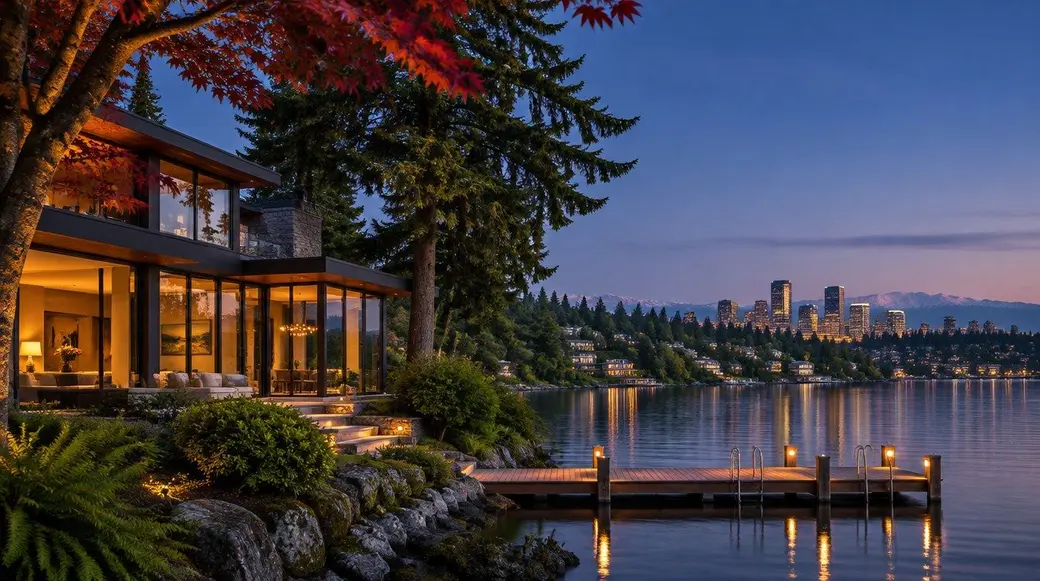
The difference is in the setting. Medina sits on the shoreline of Lake Washington, with a lakeside character defined by waterfront estates, mature trees, and long, private drives. Clyde Hill sits just to the east, up on the hill its name suggests, with a more uniform grid of single-family homes and, from the right lots, sweeping views toward the Seattle skyline, downtown Bellevue, and the mountains beyond.
I often describe it this way: Medina is about the water, and Clyde Hill is about the view.
Privacy and Presence: Where Medina Stands Apart
For clients whose careers keep them in the public eye, Medina's appeal is hard to overstate. Its estate-scale properties, gated entries, and heavily landscaped lots create privacy that comes from the land itself rather than from security systems layered on after the fact. Waterfront homes add another dimension, with private docks and direct lake access that make the home feel like a retreat rather than simply a residence.
That level of privacy comes with trade-offs. Medina's top-tier inventory is limited, and the most significant properties often change hands quietly. Waterfront homes also carry their own considerations, from shoreline regulations to dock permitting, that need careful review before you commit. This is a market where knowing what's coming before it's public, and understanding exactly what a lot allows, is part of the job.
For context, Medina's median sale price was about $4.6 million over the 12 months through October 2026, across just 35 closed sales, according to NWMLS data. With so few transactions in a given year, prices can swing noticeably from one month to the next, which is one more reason early access to what's coming to market matters here.
Everyday Livability: Where Clyde Hill Shines
Clyde Hill tends to appeal to clients who want an elevated, private home without the estate-level scale or the responsibilities that come with waterfront ownership. The neighborhood feels residential in the truest sense: quiet streets, well-kept homes, and neighbors who chose it for its calm.
For families, it's an especially practical choice. Lots are generous but manageable, and many homes balance indoor-outdoor living with room for a home office, a gym, or a dedicated recovery space without requiring an extensive renovation. Its proximity to downtown Bellevue also means dining, shopping, and the Eastside's business core are minutes away, which makes daily life simpler for clients with demanding schedules.
The view question deserves attention here. Not every Clyde Hill lot has one, and those that do command a premium. If views are a priority, it helps to know that Clyde Hill has a view and sunlight ordinance that can help restore a view a homeowner has enjoyed since buying, through a process that starts with a conversation with the neighbor and can move to mediation or the city's Planning Commission. It does not create views that were never there, and certain trees are exempt, so I always look closely at what a specific lot's view actually depends on before a client commits.
For context, Clyde Hill's median sale price was roughly $3.88 million over the 12 months through October 2026, across 32 closed sales, with a median of about 78 cumulative days on market, according to NWMLS data. That pace typically gives buyers time for thorough due diligence rather than a race to decide.
Schools and Commute: More Alike Than Different
Two of the biggest questions relocating families ask are about schools and commute, and on both fronts the neighborhoods are closely matched.
Both are served by the Bellevue School District, so families comparing the two can focus on the home and the setting rather than worrying about trading down on education. As always, school boundaries should be confirmed for any specific address.
On commute, both sit near SR 520, which connects the Eastside to Seattle across Lake Washington, and I-405 is a short drive away. Clyde Hill generally has the edge for anyone working in downtown Bellevue, while Medina's 520 access works well for Seattle-bound commuters. Whichever you're leaning toward, I always recommend testing the drive at the hours you'll actually be making it, whether that's to a team facility, a corporate campus, or Sea-Tac.
How to Decide: Questions Worth Answering Before You Tour
When a client is weighing these two neighborhoods, I ask them to answer a few questions honestly before we schedule a single showing:
- Is waterfront essential, or simply appealing? If lake access is non-negotiable, the search leans heavily toward Medina.
- How much privacy do you need day to day? Estate-scale seclusion and a more neighborly residential feel are both private, but they are not the same experience.
- How much property do you want to manage? Larger estates and waterfront homes require more ongoing upkeep and vendor coordination.
- Where will you spend most of your working hours? Downtown Bellevue and downtown Seattle can point you in different directions.
- How long do you expect to stay? A short-term role and a long-term family base often call for different priorities.
Your answers usually make the decision far clearer than any number of open houses.
The Practical Next Step
If you're relocating to the Eastside, write down your top three non-negotiables and your realistic timeline before you start browsing listings. That short list does more to narrow a search between Medina and Clyde Hill than anything else, and it allows the right agent to surface private and pre-market opportunities that match what you need.
For clients managing a move from out of state, or between seasons, much of this can be handled remotely, from virtual previews to coordinated inspections, so you only fly in for the homes that are truly worth your time. If you're working against a tight start date, my guide to relocating to Seattle mid-season walks through a realistic timeline from offer to move-in.
If you're weighing Medina vs. Clyde Hill, or you'd like a clearer picture of what's currently available on the Eastside at your price point, I'd welcome the chance to talk it through with you — no pressure, just a straightforward conversation about your options.
Amanda Aguiar
eXp Luxury Realtor® | Seattle WA 📍
Concierge Real Estate for Athletes & Executives
Categories
Recent Posts






GET MORE INFORMATION